Getting ready for the winter...

I don't even want to say it...fall is coming.  Things are still very busy here, in fact it will inevitably get much busier before it calms down but the nights are cooler and the days are shorter and it is time to prepare for the winter.  I took the last of the peas and blanched 'em, bagged 'em, and froze 'em.  Then we pulled all the plants and through them in the compost pile. In previous blog posts I wrote about the importance of crop rotation to organic farming.  It is one of the easiest ways to prevent pests and ensure a healthy crop.  Peas are an excellent source of nitrogen, they have a a symbiotic relationship with a bacteria that forms nodules on the root system.  The nodules suck nitrogen out of the air and store it in the soil.  Knowing this, we did not actually pull the plants we cut the tops of them off and left the roots in for a few days before we tilled up the empty rows.  
You can see that the peas are on their last legs
These are the nodules that attach to the root system
Peas headed to the compost pile
Now we wait for a few days to till
The picture above also shows that we left a lot of the weeds; the seed pods on these weeds are well developed this late in the season so we will not add them to the compost pile.

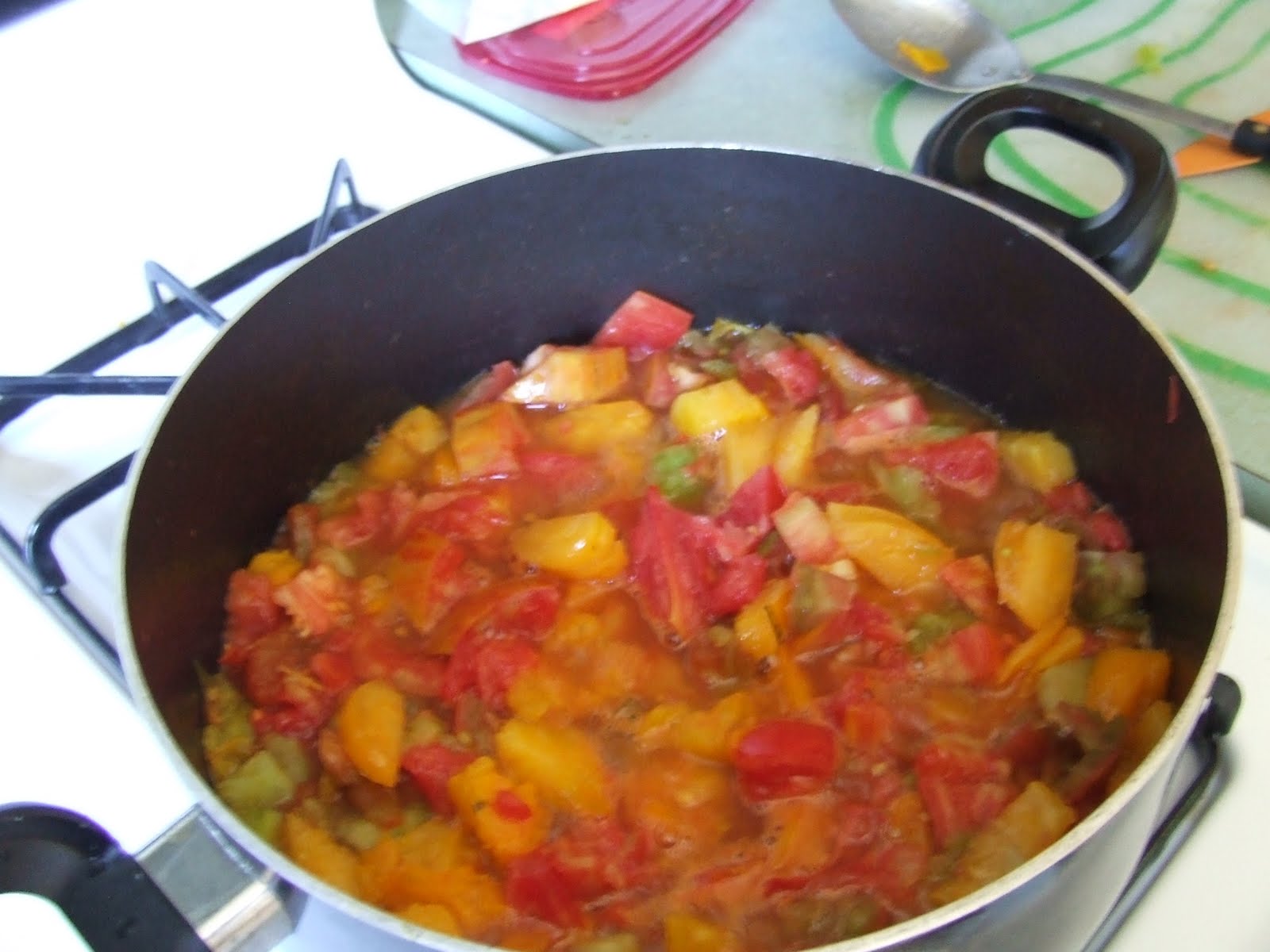
After freezing the peas, I moved onto tomatoes.  We have an unbelievable amount of tomatoes and literally can't get rid of them fast enough.  Lissa has been cooking down and freezing batches of tomatoes for the last week and I thought maybe I could help so I did my first batch last night.  We pick out any of the over ripe or funny looking ones, cut them up and throw them in a pot.  Let them stew and cook some of the water out of the tomatoes and then bag and freeze.


Now that fall is coming there are a few things to look forward to...
the trees are full of apples


Willie Nelson

I had to start the day out right...so I made bacon wrapped eggs.  I of course made extras and shared...

Ingredients:
Bacon
Eggs
Cheese (I used a provolone/mozzarella mix, you can try using Goat cheese or Cheddar)
Herbs (Chives, Thyme, Basil - whatever you have or like)

Directions;
Grease a cupcake pan and preheat the oven to 400*. Cook up your bacon until it is browned, but not crispy. Break some of your bacon into small strips and line the bottom of each cupcake hole with a strip, then curl a whole strip of bacon and set along the inside edge of the cupcake hole.
Pour 1 egg into each hole, then sprinkle cheese on top. Cook until set and extract gently (using a knife it if sticks). Sprinkle your fresh herbs and salt and pepper to taste. Eat and enjoy.

As you can see, they are super easy to make and they are soooo good.

Willie Nelson was great, I had an awesome time in Duluth.  Every time I go there I fall in love with the city a little more.
I got to hang out with an awesome group of people and it is always nice to get away from the farm...so I can be reminded how much I miss being on the farm.
On Sunday morning I woke up early to finish my playlist and drive down to Grand rapids to be on the radio.  I was so nervous, but I was so excited.  I want to be on the radio like 1,000 more times, it was so much fun and I can't wait to get back. 

Farm Chores

It is not so bad waking up on the farm, I walked into John and Lissa's house and this is what was sitting on the table.  To large ripe tomatoes and small bouquet of lilies; we will be using those tomatoes on BLT's for lunch today to celebrate the kick off of BACON MONTH!  I am not sure I have had the chance to express how much I love bacon, its salty and bad for you and I will have seconds!!!
Before lunch there is weeding to be done; each garden needs a little work here and there but between the three of us we are surprisingly keeping on top of the weeds.  There is a wedding here this weekend so this past week has been a lot of cleaning, weeding, dead-heading the flower gardens, mowing, etc.
The pea rows in the outdoor garden are starting to really slow down, when they start to yellow. We will  pick a few more times, the peas we pick will be blanched, bagged and frozen for the winter.  I will be pulling these pea plants out at the beginning of next week.
Even though the rain is helping all the vegetables grow it is also helping the weeds grow.  We have not used the small green house for a few months and when I went in there yesterday, it was totally taken over with weeds.  We will not need this greenhouse for the rest of the season so we will wait to clean it all out until this fall.
Only two of the pumpkin seeds I planted germinated.  These pumpkins are a small variety, so there will be plenty of the little guys in October.  
We have an unbelievable amount of summer squash.  Summer squash is an awesome vegetable and it is very versatile.  With a pretty mild flavor it can take on any flavor you put with it.  Similar to tofu it can be meaty enough to replace meat and creamy enough to use for a dip.  Since we have so much, I have been toying with some creative ways to cook and/or use the squash.  It has an interesting texture and I think I can come up with some fun dips/spreads. I am thinking roasted garlic, sun-dried tomato, chipotle, and maybe even a squash pesto.  Christy and I will be doing some experimenting so check the blog to see what we come up with.
The dill is starting to head, this means we can start pickling.  We are a little too busy to start right now but seeing all this dill has got me anxious to get started.

It is not stopping anytime soon...

There is so much going on here; I have been keeping very busy, so busy that it is hard to pay any attention to the blog. I first wanted to talk a little about our compost; it is one of the most important parts of this farm.  Our compost is doing so well and next year we will have lots of really nutritious soil to spread around the farm...sure to make lots of vegetables happy.
120 degrees
It is down to 120 degrees today, but just the other day I saw it at 140 degrees.  We will be adding grass clippings at the end of the week and that is the compost piles favorite food, we will surely be pushing 160 degrees by Sunday.
Last years compost, very fertile soil
You can tell the soil is fertile because it is completely overgrown.  Most of what you see here is gourd plants but there are also a bunch of tomato plants and then there are of course some weeds.  We are just going to let them go, and see what we can get out of it.  When it comes time to use the soil we will yank everything out and stir it using the bobcat which will kill any of the remaining weeds.

We are growing three different kinds of onions, red, yellow, and super sweet.  They sure are growing fast, but we wont be harvesting these for at least another month.  The picture below shows how tall the stalks are getting and below that you can see some of them starting to poke out of the ground.  I love onions and am looking forward to eating some of these.
Check out the onions
Onion flower, they are pretty cool looking.
I have never grown potatoes before and learning about them has been pretty great.  I didn't realize how long it takes to grow potatoes, these were the first thing we put in the outdoor garden and it will still be another month before we dig them out.  They grew from tiny sprouted potatoes, flowered, and are now starting to yellow; these potato plants will continue to die back but the potatoes will continue to grow.  at the end of the month we will start to dig hills and John says I will be shocked to see how many potatoes come out of there...can't wait. 
We dug a couple hills of potatoes to sell as new potatoes, these are fingerlings and red potatoes.  They are looking good.
Cucumbers are also making some serious headway.  I remember being excited when they looked like this...
 Now they look like this and are producing lots of delicious cucumbers.  We are growing at least 4 different kinds of cucumbers this year including white and lemon cucumbers.  I had the pleasure of trying my very first lemon cucumber yesterday, it was good.  It doesn't taste like lemon it just kind of looks like one. 


I spend a lot of time poking cucumbers out of the netting.
This is a white cucumber

I have taken some beautiful pictures of vegetables and flowers around the farm and thought I would share them with you.
Green bell pepper
Raspberries are in full swing, we are picking every other day
Purple and yellow beans
Dragons tongue beans
Fresh picked turnips
Cleaned and cut turnips, ready for CSA buckets
Cosmic Purple and Scarlet Nantes carrots
Colorful tomatoes
Sunflowers are starting to bloom
Sunflower
Gladiolas in the hoop house
This is my favorite gladiola
I have been working just as hard as the farm and I think I deserve a break...I am heading to Duluth this weekend to see Willie Nelson.  I am super excited and will make sure to let you know how much fun I have.  A while ago I did a post about guest hosting on KAXE (a local radio station).  I have completed the class and have done a few demos, so on Sunday from 1pm to 4pm I will be hosting my very own radio show.  I can't wait for the masses to hear my excellent taste in music. You can hear it at 91.7fm if you are living in northern Minnesota or stream it live at KAXE.org

St. Andrews Cross Spiders

That is a St. Andrews Cross spider and it scared the hell out of me when I was picking cherry tomatoes...my first thought was "run, that thing probably eats humans", fortunately my rational mind kicked in and I stood there looking at it for a while.  It is a really cool spider, the way they legs are split and the cool pattern on its back; even the web has this cool reinforcing zigzag pattern in the middle.  John did a little research and told me that they are not poisonous and are even considered beneficial to gardens because they make such large webs for catching lots of flying insects (like mosquito and deer flies). 
A few days later I was back in the hoop house picking tomatoes and I found this one...I think they are sisters or at least good friends; they probably get together for dinner.  Needless to say, next time I am picking tomatoes I am going to check and then double check before I reach through the tomato plants.
As for tomatoes, they are looking good.  We are picking more and more each week; John and Lissa told me that I will hate tomatoes by the end of the summer.  I don't believe them but I will let you know...
The cherry tomato plants are officially touching the top of the hoop house.  I will be picking tomatoes with a ladder very soon. It is a pretty impressive sight to see these huge tomato plants.

You know you are a farmer when you get excited about a new hose attachment.  The old hose attachment was run over or dropped or a combination of the two, when we got the new one I spent a little bit of time playing with all the new features.  I love a good hose attachment.  This one is definitly deluxe and I look forward to using it.

Bummer.
Deluxe
The grapes are starting to plump up.  These grapes will be red but not edible; they are very tart which makes them excellent grapes for jam and jelly.  They also make decent wine, nothing to write home about but it works if you want to get a buzz.
 While picking raspberries, John found some baby birds.  They are very cute and here you can see they are just waiting for mama to come back with some food. 

CHARD and KALE

For those of you blog readers that are part of the CSA, you have been getting swiss chard and kale every week.  For anyone reading the blog that does not participate in our CSA, here is a chance for you to learn a  little bit about 2 very awesome vegetables.
Swiss chard isn't native to Switzerland. Its actual homeland of chard lies further south, in the Mediterranean region; in fact, the Greek philosopher, Aristotle wrote about chard in the fourth century B.C. This is not surprising given the fact that the ancient Greeks, and later the Romans, honored chard for its medicinal properties. Chard got its common name from another Mediterranean vegetable, cardoon, a celery-like plant with thick stalks that resemble those of chard.
Chard is a tall leafy green vegetable; scientifically known as Beta vulgaris. Chard belongs to the same family as beets and spinach and shares a similar taste with a flavor that is bitter, pungent, and slightly salty. Swiss chard is truly one of the most incredible vegetables with its exceptionally impressive list of health-promoting nutrients.
Chard is really high in Vitamin C, K, and A; as well as 13 different antioxidants.  The amazing variety of phytonutrients in chard is apparent in its vibrant colors, including the rich, dark greens in its leaves and the rainbow of reds, purples, and yellows in its stalks and veins.  New studies have shown that chard has anti-inflammatory and detoxifing properties. Due to its high levels of calcium, magnesium, and vitamin K it also supports good bone health.  Needless to say this vegetable is awesome and you should eat as much as you can.

Here is a fun way to use your chard...

Ingredients:

1 lb. fingerling or other small potatoes (red or yellow), scrubbed but not peeled
6 slices of bacon (look for center-cut and nitrate free)
1 bunch of Swiss Chard, washed
3 Tbs. red wine vinegar, divided
3 Tbs. olive oil
2 Tbs. plain, Greek-style yogurt (preferably whole milk)
1 Tbs. German style mustard (or really any style mustard, but I like the grainy German style)
1 Tbs. real maple syrup
salt and pepper to taste

1. Put the potatoes in a large pot and fill it with just enough water to cover all of the potatoes.  Cover, bring to a boil, then turn the heat to simmer and cook until the potatoes are tender when pierced by a knife (20ish minutes).
2. Drain the potatoes, then cut the potatoes (still warm) into quarters (you can do this by putting them onto a plate and cutting them there, holding them steady as you cut with a spoon or a fork).  Put them into a large bowl and sprinkle them with 2 Tbs. of the vinegar.
3. In a large frying pan, fry the bacon over medium heat until it is crispy.  Remove to a plate lined with a paper towel or brown paper bag.
4. While the bacon is frying, cut the bottom portions of the stems off of the Swiss chard.  Chop the chard into 3 strips, lengthwise, then across into about 2 inch strips.  (This should give you pieces of chard that are around 2X2 inches.)
5. Pour off all but about 2 Tbs. of the bacon fat from the pan.  Then, add the Swiss chard to the frying pan, and cook over medium high heat until it is totally wilted, about 5-8 minutes.  Add the cooked chard to the potatoes.
6. In a small bowl, whisk together the remaining red wine vinegar, the olive oil, yogurt, mustard, and maple syrup, taste and add salt and pepper to taste (don’t forget that the bacon in the salad will add some saltiness).  Toss the dressing with the potatoes and chard.
7. Finally, chop the bacon into small pieces, and toss this into the potato salad.  Serve warm


The beautiful leaves of the kale plant provide an earthy flavor and more nutritional value for fewer calories than almost any other food around.  Kale is a leafy green vegetable that belongs to the Brassica family, a group of vegetables including cabbage, collards, and Brussels sprouts that have gained recent widespread attention due to their numerous health benefits. Kale has ruffled or flat leaves and a fibrous stalk and is usually deep green in color. It has a lively pungent flavor with delicious bitter peppery qualities.  Kale is a descendent of the wild cabbage, a plant thought to have originated in Asia Minor and to have been brought to Europe around 600 B.C. by groups of Celtic wanderers. Curly kale played an important role in early European foodways, having been a significant crop during ancient Roman times and a popular vegetable eaten by peasants in the Middle Ages. English settlers brought kale to the United States in the 17th century.  Kale's risk-lowering benefits for cancer have recently been extended to at least five different types of cancer. These types include cancer of the bladder, breast, colon, ovary, and prostate. Isothiocyanates (ITCs) made from glucosinolates in kale play a primary role in achieving these risk-lowering benefits.  Kale is now recognized as providing comprehensive support for the body's detoxification system. New research has shown that the ITCs made from kale's glucosinolates can help regulate detox at a genetic level.  Researchers can now identify over 45 different flavonoids in kale. With kaempferol and quercetin heading the list, kale's flavonoids combine both antioxidant and anti-inflammatory benefits in way that gives kale a leading dietary role with respect to avoidance of chronic inflammation and oxidative stress.

Here is a creative way to use your kale...

Kale and Bacon Muffins:

Ingredients: 

6 leaves of fresh Kale cut very thinly 
1 lb of bacon cut into small pieces 
3 eggs 
100 ml Low fat milk 
100 ml vegetable oil 
1½ cups of all- purpose flour 
1¼ cup grated Cheddar cheese 
1 cup grated Parmesan cheese
1 tbsp baking powder
 

Salt and pepper

Directions:
Pre-heat the oven to 350F. Butter and flour a medium 12 muffins tray. Cut the Kale thinly and the bacon and small peaces. Saute the bacon until crispy, spoon the bacon out and reserve. Sautee lightly the kale in the bacon fat, season with salt and pepper. Reserve and let it cool.
Meanwhile combine the eggs, milk and oil in a large mixing bowl and beat together. Add the flour, cheeses, kale, and bacon, season with salt and pepper and stir to combine (don’t over mix it) Gently fold the baking powder. Transfer to the muffin tray with an ice cream scoop. Bake for 50 minutes or until golden.